In 2025, the right dash cam is non‑negotiable for rideshare work. I prioritize full front and cabin coverage with strong low‑light performance, reliable parking protection for off‑app incidents, rock‑solid uptime in heat, and an app that doesn’t crash between trips. For Uber and Lyft, IR‑equipped cabin video is essential, and three‑channel systems add valuable rear evidence.
My criteria this year center on 4K/HDR clarity, Sony STARVIS 2 sensors or equivalent, buffered parking modes (with hardwire kits), dependable supercapacitors, discreet installs, and useful cloud features—without drowning you in false alerts. Quick note: verify local recording/consent rules, post clear signage for passengers, and lock critical clips to prevent overwrite.
COOAU Dual Dash Cam 2.5K+1080P (Front & Inside), Built-in GPS & Wi‑Fi

For Uber and Lyft drivers who need reliable road and cabin coverage, the COOAU Dual Dash Cam records the road at 2.5K and the interior at 1080P, giving you clearer detail than basic 1080p-only setups. Built‑in GPS tags speed and route on footage—helpful for fare disputes, incident reports, or proving you followed the correct route.
Wi‑Fi connectivity plus a companion app lets you preview and pull clips to your phone between rides without removing the card. The compact dual‑lens design keeps installation tidy, and the always‑on recording approach helps ensure key moments are captured. Overall, it’s a strong value pick for rideshare pros who want front‑and‑inside evidence without overspending.
Pros:
- 👍 Dual-channel coverage (2.5K front + 1080P cabin) tailored for rideshare safety.
- 👍 Built‑in GPS logs route and speed for clear trip verification.
- 👍 Wi‑Fi and app access make on-the-go review and sharing convenient.
- 👍 Strong feature-to-price ratio for Uber/Lyft drivers.
Cons:
- 👎 Not 4K; long-distance plate capture won’t match higher‑resolution cams.
- 👎 App setup and settings may take a bit of learning for first-time users.
- 👎 Wi‑Fi transfers can be slower than exporting directly from the memory card.
COOAU D30S 4K Dash Cam with GPS Wi‑Fi (Front & Inside Dual 2.5K + 1080P)

The COOAU D30S is a strong pick for Uber and Lyft drivers who need clear evidence inside and out. It offers high‑resolution front capture and an inside cabin camera with infrared night vision, so passenger activity is recorded even in pitch‑black conditions. Built‑in GPS logs speed and route, while Wi‑Fi lets you review and offload clips to your phone without removing the card—ideal when you need to share an incident quickly.
Video quality is impressive for the price, especially during the day, and the cabin IR works reliably for late‑night rides. Just note that resolution typically drops when running both channels simultaneously, and Wi‑Fi transfers can feel slow for large 4K files.
Pros:
- 👍 Dual coverage (front + cabin) designed for rideshare safety and dispute resolution
- 👍 Infrared cabin night vision captures clear passenger footage in the dark
- 👍 Built‑in GPS for speed/location overlay and incident documentation
- 👍 Wi‑Fi app control for quick clip review and sharing
Cons:
- 👎 Dual‑channel recording reduces maximum resolution/bitrate compared to single‑channel
- 👎 Wi‑Fi transfers and app connectivity can be sluggish with large files
- 👎 IR LEDs may reflect on certain windshield/tint setups, requiring placement tweaks
Milerong X25 Dual Dash Cam (Front & Inside, 1080P, 64GB Included)

For rideshare work, the Milerong X25 covers what matters: simultaneous front and cabin recording in 1080P, plus infrared night vision so the interior stays clear during late-night trips. Setup is painless, and the included 64GB microSD means you can hit the road right away. Loop recording keeps footage rolling without manual cleanup, so incidents are captured even on long shifts.
While HD quality is adequate for documenting events, it’s not as crisp as 2K/4K options for reading plates at speed. Still, for Uber and Lyft drivers prioritizing reliable evidence, passenger visibility, and a low‑maintenance install, the X25 delivers strong value.
Pros:
- 👍 Dual front + cabin coverage protects against disputes and false claims
- 👍 Infrared interior night vision keeps passengers visible on dark rides
- 👍 64GB card included; genuinely plug‑and‑play
- 👍 Continuous loop recording reduces storage hassles
Cons:
- 👎 1080P on both lenses; less detail than higher‑resolution models
- 👎 No explicit GPS or Wi‑Fi/app integration
- 👎 64GB can cycle quickly on marathon shifts; export critical clips promptly
ROVE R2-4K DUAL Dash Cam Front and Rear

The ROVE R2-4K DUAL is a strong pick for Uber and Lyft drivers who need reliable front and rear coverage. Its STARVIS 2 sensor delivers crisp detail and improved low‑light performance, while 5GHz Wi‑Fi (up to 20MB/s) makes offloading incident clips to your phone fast between rides. ROVE includes a 128GB card in the box, so you can start recording immediately without extra purchases.
As a rideshare option, it excels at documenting road-facing events and rear-end encounters. However, note that this dual setup is designed for exterior coverage; it doesn’t include a dedicated interior IR cabin cam for monitoring passengers at night. If cabin footage is essential for you, consider pairing it with an interior-focused model.
Pros:
- 👍 Dual-channel coverage with sharp 4K front recording
- 👍 STARVIS 2 sensor enhances night clarity for city driving
- 👍 5GHz Wi‑Fi with up to 20MB/s for quick clip transfers
- 👍 FREE 128GB microSD included—ready to use out of the box
Cons:
- 👎 No interior IR cabin camera—less ideal for documenting passenger incidents
- 👎 Parking mode typically requires a hardwire kit for best results
- 👎 Rear camera cable routing can take time in larger vehicles
VANTRUE N4 3 Channel Dash Cam
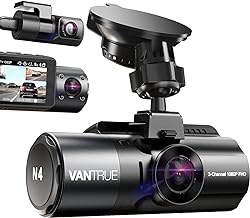
For Uber and Lyft drivers who need full coverage and clear evidence day or night, the Vantrue N4 is a standout. It records three angles at once—front, cabin, and rear—with strong low‑light performance from the interior IR camera. In dual‑channel mode you get up to 4K front + 1080p rear; in triple‑channel, expect 1440p front + 1440p cabin + 1080p rear, which is more than sufficient for licenses, faces, and behavior inside the car.
A heat‑resistant supercapacitor makes it reliable for long shifts and hot dashboards. Parking mode supports motion/impact detection (best with a hardwire kit), while the G‑sensor locks critical clips. Overall, it’s a durable, discreet choice tailored to rideshare risk profiles.
Pros:
- 👍 True three‑channel coverage (front/cabin/rear) with IR cabin cam ideal for rideshare incidents
- 👍 Sharp footage: up to 4K front in dual; 1440p front+cabin in triple, with solid night vision
- 👍 Heat‑resistant supercapacitor and discreet design for continuous, high‑duty use
- 👍 Buffered parking mode and G‑sensor event locking; quick mic mute for privacy
- 👍 Supports high‑endurance microSD cards up to 256GB
Cons:
- 👎 No built‑in Wi‑Fi/app or cloud—footage transfer is via card or cable
- 👎 GPS logger sold separately
- 👎 Parking mode requires a hardwire kit for best results
- 👎 Large file sizes demand ample, high‑endurance storage
Juscar 2.5K + 1080P Dual Dash Cam (Front & Inside) with Wi‑Fi & GPS

For Uber and Lyft drivers who want clear front and cabin coverage without fuss, the Juscar dual dash cam nails the essentials. You get a sharp 2.5K front view plus 1080P interior with IR night vision—great for capturing passengers and plates in low light. Built‑in GPS adds speed/location data to clips, and Wi‑Fi makes it easy to pull footage to your phone when you need to share incidents with support. The 3-inch IPS screen simplifies setup, and the included 32GB card means you can start recording right away.
If you don’t need a rear camera, this is a strong, value‑focused pick for day‑to‑night protection and incident documentation.
Pros:
- 👍 Dual-channel coverage (2.5K front + 1080P cabin) ideal for rideshare evidence
- 👍 IR night vision keeps interior faces clear after dark
- 👍 Built‑in GPS for speed/location stamping on clips
- 👍 Wi‑Fi app control for quick clip review and sharing
- 👍 32GB card included to start recording out of the box
Cons:
- 👎 32GB fills quickly at 2.5K; plan to upgrade to a larger card
- 👎 No rear camera—three‑channel systems offer fuller coverage
- 👎 Wi‑Fi transfers can be slower than using the microSD card directly
Dash Cam Front and Inside (1080P + 1080P) with 64GB Card

For Uber and Lyft drivers, this dual-lens FHD dash cam records both the road ahead and your cabin at 1080p, capturing the context you need for accidents and rider disputes. The included 64GB card lets you install and start recording right away—no extra accessories required.
Daytime clarity is solid, and the compact form factor tucks neatly behind a mirror to stay low-profile for passengers. If you want higher-end add-ons like GPS or app control, look upmarket; but as a dependable, entry-friendly workhorse, it nails the essentials for rideshare safety and documentation.
Pros:
- 👍 Dual 1080p coverage of road and cabin—ideal for rideshare safety and evidence.
- 👍 Includes a 64GB microSD card for immediate, out-of-the-box use.
- 👍 Compact, straightforward setup that stays discreet in daily service.
Cons:
- 👎 1080p isn’t as detailed as 2K/4K for reading plates at speed.
- 👎 Front + interior lenses only—no dedicated rear-exterior camera.
- 👎 64GB can fill quickly with dual-channel footage; expect frequent overwrites.
Dash Cam Front and Rear, 2.5K+1440P Triple Car Camera with 32GB Card (3-Channel, G‑Sensor, 3.16” IPS)

This budget-friendly 3‑channel setup covers the front road, cabin, and rear—exactly what Uber and Lyft drivers need for rider disputes and incident documentation. The front camera’s 2.5K/1440p clarity helps with plate recognition, while the 3.16-inch IPS screen makes on-the-spot playback and settings changes straightforward. A G‑sensor auto-locks critical clips, and the included 32GB card gets you recording right out of the box.
Installation is manageable, though routing the rear cable takes patience. For daily rideshare shifts, the bundled card will fill quickly with three feeds—plan to upgrade to a larger, high‑endurance microSD. There’s no clear mention of built‑in GPS, so verify if you need speed/location stamps for your records.
Pros:
- 👍 True three‑channel coverage (front/interior/rear) ideal for rideshare safety and liability.
- 👍 2.5K front resolution improves plate and detail capture; IPS screen eases setup and review.
- 👍 G‑sensor auto‑locks incidents; 32GB card included for out‑of‑box recording.
- 👍 Strong value versus many branded 3‑channel kits.
Cons:
- 👎 32GB fills fast with three streams; upgrade to a larger high‑endurance card.
- 👎 No clear mention of GPS—confirm if you need speed/location logging.
- 👎 Rear camera wiring can be time‑consuming for first‑time installers.
- 👎 Firmware/support polish may be basic compared with premium brands.
Buyer’s Guide
What to prioritize for rideshare work
– Dual-channel coverage: a 1440p (or higher) front camera plus 1080p interior with infrared for clear night footage of passengers. – HDR + wide-yet-sensible FOV: 130–150° to capture lanes without severe distortion; HDR helps with glare and tunnels. – Heat resilience and reliability: supercapacitor power, high operating-temp rating, and an adhesive low-profile mount to survive daily use. – GPS with toggles: enable time/location stamps when you need evidence; hide speed if local rules or personal preference call for it. – Parking protection: buffered parking mode (pre-roll) with impact/motion triggers if you work late and park on-street.
Power, mounting, and setup
– Power: use a hardwire or OBD-II kit with a low-voltage cutoff for reliable parking mode; cigarette adapters are fine for shift-only recording. – Cable routing: tuck along the headliner and the passenger-side A-pillar, avoiding airbag paths; clean glass before mounting. – Glare control: add a CPL filter if your dash is reflective; angle the interior camera slightly downward to minimize mirror glare. – Firmware and app: update before first use, set correct timezone, and test voice lock/manual event buttons so you can save clips fast.
Storage, cloud, and privacy
– Endurance microSD: 256–512GB high-endurance cards reduce corruption and give all-day coverage; set loop length to 1–3 minutes. – Cloud/LTE: worth it for auto-uploaded incidents and live alerts; otherwise, rely on phone Wi‑Fi offload after each shift. – Privacy: post a “Video/Audio Recording May Occur” notice; know your state’s consent laws and keep an easy audio on/off toggle. – Data hygiene: lock only relevant clips, back up promptly, and auto-delete older footage to protect rider privacy and free space.
Helpful FAQ Section
Q: Do I really need a dual-channel dash cam with IR for Uber?
A: Yes. A front + interior IR setup is the standard for rideshare—clear cabin footage at night is crucial for safety, disputes, and incident reports.
Q: How much storage do I need for long shifts in 2025?
A: For two channels (1440p front + 1080p IR cabin), expect about 15–20 hours on 256GB and 30–40 hours on 512GB, depending on bitrate and HDR settings.
Q: Will parking mode drain my battery?
A: Use a hardwire/OBD kit with a low-voltage cutoff. Typical draw is a few hundred mA; if you park for long periods, consider a dedicated dash cam battery pack.
Q: Should I record audio and show speed/GPS on video?
A: Audio and speed stamps help context, but laws vary. Keep an audio toggle, post a recording notice, and disable speed overlay if that better fits local rules or your comfort. This is not legal advice.
Q: How do I prevent overheating in summer?
A: Choose a supercapacitor model with a high temp rating, park in shade, use a windshield sunshade, and turn off Wi‑Fi/LTE when parked to reduce heat.
Q: Can dash cam footage help with Uber support or insurance claims?
A: Yes. Timestamped, clear footage (ideally with GPS) is often accepted for incident reviews and claims. Back up the original files and share only necessary clips.
Final Verdict
For Uber drivers in 2025, the best dash cams combine dual-channel coverage with infrared interior video, HDR clarity, strong heat tolerance, and dependable parking protection. Cloud features add peace of mind with auto-uploads, but a large endurance microSD still suits most budgets. Recommendation: – Most drivers: choose the Best Overall pick from our roundup—dual 2K/1080p with IR, supercapacitor, GPS toggles, and buffered parking mode. – Budget-focused: our Value pick delivers reliable 1080p IR cabin and 1440p front without LTE fees. – Set-it-and-forget-it: the Premium/Cloud pick auto-uploads locked events and is ideal if you often park on-street. Whichever you choose, prioritize clear interior night video, a low-profile mount, and a power setup with battery protection. That combination delivers the evidence and reliability rideshare work demands.