There’s nothing quite like the gleam of a fresh respray, a flawless canvas promising renewed pride and protection for your vehicle. That first instinct to lock in that showroom shine with a coat of wax is powerful, but acting on it too hastily is one of the most costly mistakes a car owner can make. Preserving that perfect finish hinges entirely on understanding a single, critical factor: the paint’s curing timeline, a period of patience that separates a stunning result from a ruined one.
The primary risk lies in sealing the surface before the paint has finished off-gassing, a process where solvents slowly evaporate from the new coating. Applying a wax or sealant too soon creates a barrier that traps these solvents beneath, which can lead to hazing, cloudiness, and a soft film that never properly hardens. Furthermore, the fresh paint remains incredibly delicate; using aggressive cleaners, abrasive polishes, or even the wrong type of “safe” wax can microscopically mar the surface or prevent the paint from forming a strong, lasting bond with its underlying layers, compromising its durability from the start.
The solution is a disciplined, informed approach centered on time and product selection. Most professional shops recommend waiting a minimum of 60 to 90 days before applying any form of protective wax or sealant, allowing for full solvent evaporation and paint hardening. When the waiting period is over, the first application must be a product specifically formulated as safe for new paint—typically a gentle, non-abrasive synthetic sealant or a pure carnauba wax without harsh cleaners. This careful methodology transforms your patience into a powerful payoff: a resilient, high-gloss shield that fully protects your investment for years to come.
CAR GUYS Hybrid
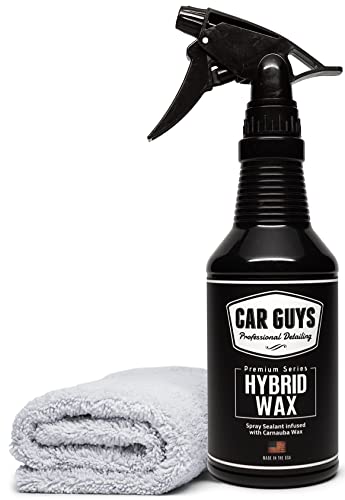
Who It’s For: This is a premium ceramic spray for car owners who want professional-level protection without the professional-level effort or price.
- Weekend detailers seeking a durable, high-gloss finish in minutes.
- Daily drivers wanting long-term protection against water spots and UV damage.
- Anyone who values slickness and hydrophobic beading over a bargain-basement price.
Core Performance: CAR GUYS Hybrid delivers a slick, high-gloss ceramic coating with impressive ease. It beads water aggressively for months and provides a smooth, contaminant-resistant surface.
- Creates a deep, wet-looking shine with strong hydrophobic properties.
- Applies and wipes off easily compared to more finicky ceramic sprays.
- Uses a blend of SiO2 and other polymers for durable, long-lasting protection.
- Requires proper surface prep (wash & decontaminate) for the advertised 6-month longevity.
Final Verdict: This is a top-tier spray coating that justifies its price with exceptional performance and ease of use. It bridges the gap between quick detailers and professional coatings perfectly.
- Buy if: You want durable, high-gloss protection with minimal effort.
- Skip if: You need the absolute cheapest maintenance spray or dislike any application effort.
Pros:
- Creates an incredibly slick, high-gloss finish.
- Strong, long-lasting hydrophobic water beading.
- Very easy to apply and wipe off without high spots.
- Good durability for a spray-on product (3-6 months).
Cons:
- Premium price point compared to basic spray waxes.
- Performance depends heavily on proper paint prep first.
Buyer’s Guide: How to Choose
Choosing the right espresso machine is about matching its capabilities to your skill level and daily routine. This guide focuses on the key factors that separate a frustrating purchase from a perfect one, helping you navigate the trade-offs between convenience, control, and cost.
1. Machine Type & Your Commitment Level
Your daily commitment to the process is the most critical choice. Manual lever machines offer ultimate control but demand skill and time. Semi-automatics provide a hands-on balance of grinding, dosing, and tamping, ideal for hobbyists. Super-automatics grind, tamp, and brew at the push of a button, prioritizing speed and consistency for busy households. Start by honestly assessing how many minutes you want to spend per drink.
2. Boiler System & Performance
The boiler type dictates your ability to brew and steam milk simultaneously. Single boilers are affordable but require a wait between pulling a shot and steaming. Heat exchange (HX) boilers allow for both functions at once, though they require temperature management. Dual boilers offer independent, precise control for each task and are essential for back-to-back drinks without compromise. This factor matters most if you regularly make milk-based drinks or serve multiple people.
3. Pressure Stability & Temperature Control
Consistent pressure (ideally 9 bars) and precise temperature are the unsung heroes of flavor. A machine with a reliable pump and good thermal stability (often via a PID controller) will extract the nuanced sweetness and acidity from your beans shot after shot. Investing here directly affects long-term satisfaction by ensuring your machine doesn’t become the limiting factor as your skills and coffee quality improve.
Frequently Asked Questions
Q1: Is a built-in grinder necessary?
A1: Not necessary, but highly recommended for freshness. A quality separate grinder often offers more flexibility and better performance for the price, but a built-in grinder on a super-automatic or some semi-automatics saves counter space and streamlines the workflow.
Q2: How important is a PID controller?
A2: Crucial for consistency if you enjoy straight espresso. A PID digitally regulates water temperature to within a degree, eliminating the guesswork and sour/bitter swings of analog thermostats. For milk drinks where milk masks subtleties, it’s less critical.
Q3: Can I use pre-ground coffee or pods?
A3> Many machines offer a dual-purpose filter basket for pre-ground coffee, but you’ll sacrifice freshness and crema. Pod compatibility (like ESE) is machine-specific and convenient but limits your bean choice and increases per-cup cost compared to fresh beans.
Final Recommendation
For the beginner seeking a simple, all-in-one solution, a quality super-automatic is the best fit. The aspiring home barista should prioritize a semi-automatic with a PID and pair it with a good burr grinder for the ideal balance of control and learning. For households that serve multiple lattes daily or the serious enthusiast, a dual-boiler machine is a worthwhile long-term investment. Your choice ultimately hinges on whether you value the ritual of making coffee or the immediacy of the final drink. For the latest models in 2026, focus on machines with improved energy efficiency and more intuitive touch interfaces.