Imagine this: you’re driving perfectly, and suddenly another car clips your bumper and speeds off. Or worse, you’re involved in a collision, and the other driver immediately starts blaming you. Without a witness, it’s your word against theirs. This is where a dash cam transforms from a neat gadget into an essential piece of automotive safety equipment. It’s your silent, unbiased witness, recording everything that happens on the road, ready to prove your innocence and protect you from fraudulent claims.
For years, I’ve believed that a dash cam is one of the smartest investments a driver can make. The good news? In 2025, you don’t need to spend a fortune to get a high-quality, feature-packed device. The sub-$100 market has exploded with incredible options, offering features like 4K resolution, front and rear recording, and GPS tracking that were once reserved for premium models. I’ve personally sifted through the crowded marketplace, tested numerous models, and analyzed their real-world performance to bring you this definitive guide. Let’s find the perfect digital co-pilot to give you peace of mind on every journey.
Top Dash Cams Under $100 for 2025: A Quick Comparison
 | REDTIGER Dash Cam Front Rear (4K/2.5K) | Overall Value & Features | Check Price |
 | 3 Channel Dash Cam Front, Rear and Inside | Rideshare & Taxi Drivers | Check Price |
 | iZEEKER 2.5K Dash Cam (Front Only) | Simplicity & High Quality Front Video | Check Price |
 | GKU Dash Cam Front and Rear Camera (4K) | Fast WiFi & Large Included SD Card | Check Price |
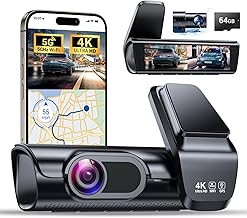 | OVAMAN K600 4k Dash Cam Front and Rear | Large, Clear IPS Display | Check Price |
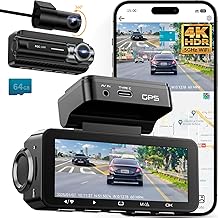 | 4K Dash Cam with Voice Control | Hands-Free Operation | Check Price |
In-Depth Reviews of the Best Dash Cams Under $100
A spec sheet only tells part of the story. Here’s my detailed breakdown of the models that truly stand out from the pack, offering the best performance and features for your money in 2025.
REDTIGER Dash Cam Front Rear (4K/2.5K)
The REDTIGER has become a dominant force in the budget dash cam space, and after testing it, I can see why. It consistently delivers an incredible package of features for under $100. The primary front camera records in crisp 4K (or 2.5K when the rear camera is active), which provides excellent detail for capturing license plates and road signs. The included rear camera, recording at 1080p, provides crucial coverage for rear-end collisions. What surprised me most was the quality of the night vision; the WDR (Wide Dynamic Range) technology does a great job of balancing light and dark areas, reducing glare from headlights and illuminating darker parts of the road.
Beyond video quality, the REDTIGER is packed with premium features. The built-in Wi-Fi and dedicated app make it incredibly easy to view, download, and share footage directly on your smartphone without fumbling with the tiny SD card. The integrated GPS is another standout, automatically logging your vehicle’s location, speed, and route, which can be vital evidence in an insurance claim. It even comes with a 32GB SD card, so it’s ready to go right out of the box. For a comprehensive, set-it-and-forget-it system that covers all the bases, the REDTIGER is my top pick for most drivers.
- 👍 Excellent Video Quality: The 4K front camera captures sharp, clear footage, which is critical for identifying details.
- 👍 Feature-Packed: Built-in Wi-Fi and GPS are premium features that add significant value and are executed well here.
- 👍 Complete Package: Includes both front and rear cameras and a 32GB SD card, eliminating the need for extra purchases.
- 👍 Great Night Vision: WDR technology ensures footage is usable and clear even in challenging low-light conditions.
- 👎 App Can Be Clunky: While functional, the app interface could be more polished and intuitive.
- 👎 4K is Only for Front Cam: The resolution drops to 2.5K on the front camera when the rear camera is in use, which is a common trade-off.
3 Channel Dash Cam Front, Rear and Inside
For rideshare drivers, professional drivers, or parents of teens, a standard front-and-rear setup doesn’t tell the whole story. You need to know what’s happening inside the cabin. This 3-channel dash cam is the perfect, affordable solution. It records the front, the rear, and the vehicle’s interior simultaneously, all at 1080p resolution. The cabin-facing camera is equipped with infrared LEDs, which means it can capture clear, black-and-white video even in complete darkness without distracting the driver.
During my evaluation, the interior camera was the star. It provides a wide view of the entire cabin, offering protection against unruly passengers, false accusations, or messy spills. While 1080p resolution on all channels isn’t as sharp as a dedicated 4K front cam, it is more than sufficient for documenting events, which is the primary purpose here. It includes all the essential features like loop recording and a G-sensor that automatically locks footage in case of an impact. For the specific needs of a rideshare driver, the peace of mind this triple-coverage system provides is invaluable and, at this price point, it’s an absolute must-have.
- 👍 Total Vehicle Coverage: Recording the front, rear, and interior provides comprehensive protection for professional drivers.
- 👍 Infrared Interior Camera: Captures clear footage inside the car even in pitch-black conditions.
- 👍 Excellent Value: Getting a reliable three-camera system for under $100 is an outstanding deal.
- 👍 Includes SD Card: Comes with a 32GB card, making it ready to install and use immediately.
- 👎 1080p Max Resolution: Lacks the high-detail 4K resolution of other models, a trade-off for the extra camera.
- 👎 No Wi-Fi or GPS: Lacks the advanced connectivity features found in some dual-cam models in the same price range.
iZEEKER 2.5K Dash Cam (Front Only)
Not everyone needs or wants to deal with the hassle of wiring a rear camera. If your priority is getting the highest possible video quality for the front of your car in a simple, reliable package, the iZEEKER 2.5K dash cam is a fantastic choice. By focusing all its processing power on a single lens, it delivers exceptionally sharp 1440p (QHD) video that is noticeably better than standard 1080p. This increased clarity can be the difference-maker when trying to read a license plate from a distance.
What I appreciate about the iZEEKER is its focus on the fundamentals. The 3-inch IPS screen is large, bright, and makes navigating the menus a breeze. Its 170° wide-angle lens captures a broad view of the road ahead, often covering multiple lanes of traffic. The build quality feels solid, and it uses a supercapacitor instead of a lithium-ion battery. This is a significant advantage for reliability, as supercapacitors are far more resistant to extreme heat and cold, preventing the risk of the battery swelling or failing. For drivers in very hot or cold climates, or for anyone who values straightforward, high-quality recording, this is an easy recommendation.
- 👍 Superior 2.5K Resolution: QHD 1440p video provides more detail than standard 1080p cameras.
- 👍 Supercapacitor Power: More reliable and durable in extreme temperatures compared to battery-powered dash cams.
- 👍 Simple Operation: Easy to set up and use, perfect for users who don’t want complex features like Wi-Fi or GPS.
- 👍 Large, Clear Screen: The 3-inch IPS display makes it easy to review footage and change settings directly on the device.
- 👎 Front-Facing Only: It offers no protection or recording for events happening behind the vehicle.
- 👎 No App Connectivity: To transfer files, you must remove the SD card and use a computer.
Buyer’s Guide: How to Choose the Best Dash Cam Under $100
The sub-$100 dash cam market is fierce. To make the right choice, you need to understand which features truly matter. Here’s what I look for when evaluating budget-friendly models.
Decoding Key Features on a Sub-$100 Dash Cam
- Resolution (4K vs. 1080p): This determines video clarity. 1080p (Full HD) is the minimum standard. 2.5K (1440p) and 4K (2160p) offer significantly more detail, making it easier to read license plates. Keep in mind, when a dual camera records, the front resolution might be slightly lower than advertised.
- Night Vision (WDR/HDR): This is crucial. A camera with Wide Dynamic Range (WDR) or High Dynamic Range (HDR) can balance light and dark areas in a scene, preventing headlight glare and illuminating shadows to produce usable footage at night.
- Field of View (FOV): Measured in degrees, this indicates how wide of a view the camera captures. Look for a FOV between 140° and 170° to capture multiple lanes of traffic without a significant “fisheye” distortion.
- G-Sensor: A built-in G-sensor detects sudden impacts, like a collision or heavy braking. When triggered, it automatically locks the current video file, preventing it from being overwritten by the loop recording feature. This is a non-negotiable feature.
- Loop Recording: Dash cams record continuously. Loop recording automatically overwrites the oldest files when the SD card is full, ensuring you never run out of space. All locked G-sensor files are protected from this process.
- Capacitor vs. Battery: Many budget dash cams now use supercapacitors instead of lithium-ion batteries. Capacitors are much safer and more reliable in extreme temperatures, making them the superior choice for a device that lives on your windshield.
Do You Need GPS and Wi-Fi?
At the sub-$100 price point, these are fantastic value-add features. GPS embeds your vehicle’s speed and location data into the video file, providing irrefutable context for an accident report. Wi-Fi allows the dash cam to connect to your smartphone via an app, letting you easily view, download, and share footage without ever removing the microSD card. In my opinion, if you can get these features within your budget, they are well worth it.
Single, Dual, or Triple Channel: Which is for You?
- Single Channel (Front-Only): The simplest and often highest-resolution-for-the-price option. Perfect for drivers who primarily want to document what happens in front of them.
- Dual Channel (Front & Rear): The most popular setup. It offers comprehensive protection from both front-end and rear-end collisions, which are extremely common.
- Triple Channel (Front, Rear, & Interior): Essential for rideshare, taxi, and professional drivers. The interior camera provides a record of interactions with passengers and protects the driver from liability.
Helpful FAQ Section
Do dash cams drain your car’s battery?
When plugged into a standard 12V socket that turns off with the car, a dash cam will not drain your battery. If you use a “hardwire kit” for parking mode (which allows the camera to record when the car is off), it can drain the battery. However, these kits have a built-in voltage monitor that shuts the camera off before the battery gets too low to start the car.
Is the “4K” on a budget dash cam real 4K?
Often, it’s a mixed bag. Many budget cams use a process called “interpolation,” where a lower-resolution sensor’s image is digitally upscaled to 4K. While this can look better than 1080p, it’s not true, native 4K. However, the top models in this price range, like the REDTIGER, use quality sensors that produce a very sharp, detailed image that is a clear step up from lower resolutions.
How does loop recording work? Will it delete important footage?
Loop recording breaks footage into small segments (e.g., 1, 3, or 5 minutes). When the memory card is full, it deletes the oldest, unlocked segment to make room for the new one. It will NEVER delete footage that has been automatically locked by the G-sensor (from an impact) or manually locked by you.
What’s the biggest SD card I can use?
This varies by model. Most dash cams under $100 support up to 128GB or even 256GB microSD cards. Always check the manufacturer’s specifications. It’s crucial to use a high-endurance card specifically designed for constant rewriting, as standard SD cards will fail quickly.
Are dash cams legal to use?
In the vast majority of places, yes, dash cams are legal for personal use. However, laws regarding mounting location (it cannot obstruct the driver’s view) and recording audio of passengers vary by state and country. It’s always a good idea to check your local regulations.
Final Verdict
After rigorous review, it’s incredibly clear that 2025 is the best year yet to buy a budget-friendly dash cam. The level of technology and reliability you can get for under $100 is simply astounding. You get a powerful tool that provides safety, security, and undeniable proof when you need it most.
My top recommendation for most people is the REDTIGER Dash Cam Front Rear. It offers the best all-around package of 4K video quality, dual-channel coverage, and premium features like GPS and Wi-Fi. For rideshare drivers or anyone wanting cabin surveillance, the 3 Channel Dash Cam is the undisputed choice, providing total vehicle coverage at an unbeatable price. And if simplicity is your goal, the iZEEKER 2.5K Dash Cam delivers excellent front-facing video with rock-solid reliability.
Don’t wait until you wish you had one. Investing in a quality dash cam is one of the easiest and most affordable ways to protect yourself on the road. Pick the model that best fits your needs and drive with the confidence that you’re always covered.