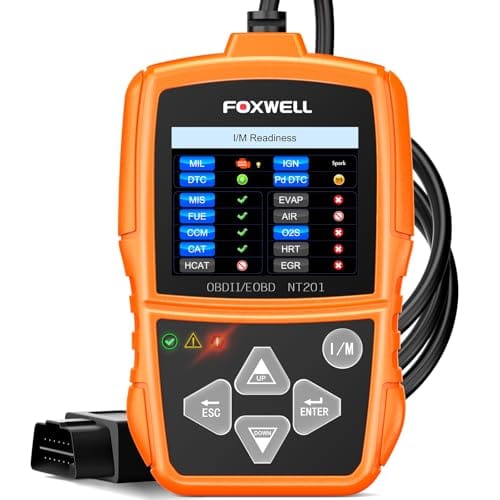
That dreaded check engine light can turn a good day sour. What does it mean? How serious is it? And how much will the repair cost? Before you call a mechanic and brace for a big bill, there’s a simple, affordable tool that can give you answers: a budget OBD2 scanner.
But with so many options available, which one should you choose? We’ve done the research for you. This review breaks down the best budget-friendly OBD2 scanners on the market, comparing their key features to help you find the right tool to diagnose your car and save money.
| Product Image | Product Name | Best For | Check Price |
|---|---|---|---|
 | ANCEL AD310 Enhanced Universal S | Basic Code Reading | Prices |
 | BlueDriver Bluetooth Pro Scanner | Smartphone Integration | Prices |
 | FOXWELL NT301 Live Data Scanner | Reliable Live Data | Prices |
 | ZMOON ZM201 Professional Scanner | Professional Features | Prices |
 | TOPDON AD500 OBD2 Scanner | All-in-one Value | Prices |
 | FIXD Bluetooth OBD2 Scanner | App Simplicity | Prices |
 | XTOOL OBD2 Diagnostic Tool | Wide Vehicle Coverage | Prices |
 | Generic OBD2 Diagnostic Tool | Ultra-budget Option | Prices |
ANCEL AD310 Enhanced Universal S
If you’re a DIY car owner who wants to read and clear check engine lights without any fuss, the ANCEL AD310 is an excellent choice.
Its standout feature is a clear, color screen that displays live data in easy-to-read text and numbers, not confusing codes. For example, you can watch your engine’s coolant temperature rise in real-time to check if your thermostat is stuck, making diagnosis straightforward.
Beyond the screen, the AD310 feels surprisingly durable with a robust build and a protective rubber sleeve. It’s a straightforward scanner that excels at its core job, making it a reliable and powerful option for anyone on a budget.
Pros:
- 🟢 Excellent color screen that displays data in plain English
- 🟢 Incredibly easy to use with one-click smog check readiness
- 🟢 Durable build quality with a protective rubber casing
- 🟢 Wide vehicle compatibility covering most cars sold in the US
Cons:
- 🔴 Lacks advanced features like ABS or airbag system scanning
- 🔴 Cannot graph live data, only shows numerical values
- 🔴 The display can be difficult to read in direct sunlight
BlueDriver Bluetooth Pro Scanner
For DIYers who want professional-grade diagnostic data without the professional price tag, the BlueDriver Bluetooth Pro Scanner is a top contender.
Its biggest strength is the free companion app, which provides the same detailed repair reports a mechanic might use. For instance, if your check engine light is on for a P0420 code, BlueDriver won’t just show the code; it will list the most likely causes—like a faulty catalytic converter or oxygen sensor—and even suggest specific tests to run.
Beyond the smart software, the scanner itself is built to last with a sturdy, compact design that feels great in your hand. While it’s a premium pick in the budget category, the depth of information it provides makes it an incredibly strong and reliable choice for anyone serious about car maintenance.
Pros:
- 🟢 Provides detailed, mechanic-level repair reports
- 🟢 The free, regularly updated app is intuitive and user-friendly.
- 🟢 Scans both generic OBD2 and manufacturer-specific trouble codes.
- 🟢 Hardware is compact, sturdy, and well-constructed.
Cons:
- 🔴 More expensive than many basic budget OBD2 scanners.
- 🔴 Requires a smartphone and a stable Bluetooth connection to function.
- 🔴 Some advanced features may have a learning curve for beginners.
FOXWELL NT301 Live Data Scanner
For DIY car owners who want to understand their vehicle better without a confusing professional-grade tool, the FOXWELL NT301 is an excellent choice.
Its standout feature is live data streaming, which shows real-time readings from your engine’s sensors. You can watch the oxygen sensor voltage fluctuate or monitor coolant temperature as you drive, helping to pinpoint intermittent issues a basic code reader might miss.
Beyond its smart functions, the NT301 feels surprisingly durable and has a clear, easy-to-read screen. It’s a strong option because it delivers professional-level information in a simple, one-click package that anyone can use right out of the box.
Pros:
- 🟢 Excellent live data streaming for real-time diagnostics.
- 🟢 Extremely easy to use with intuitive, one-click operation.
- 🟢 Reads and clears codes for all OBD2-compliant vehicles.
- 🟢 Compact design with durable build quality.
- 🟢 Very affordable for the features it offers.
Cons:
- 🔴 Lacks advanced features like bi-directional control.
- 🔴 Limited to basic OBD2 functions and cannot read specific manufacturer codes.
- 🔴 The screen may feel small for some users.
ZMOON ZM201 Professional Scanner
If you’re a DIY car enthusiast seeking professional-level diagnostics without the professional price, the ZMOON ZM201 is a perfect fit.
Its standout feature is the ability to read and clear codes for all vehicle systems, not just the engine. This means you can reset an airbag light or diagnose an ABS issue right from your driveway. For example, if your check engine light and traction control light are both on, this tool can find the connection and help you fix it for good.
We also appreciate its robust design and large, clear screen. The menu is incredibly simple to navigate, making it a stress-free tool for beginners. For its low cost, the ZMOON ZM201 delivers exceptional value and diagnostic power, making it a top contender for anyone serious about car maintenance.
Pros:
- 🟢 Reads and clears codes for all car systems (ABS, Airbag, etc.).
- 🟢 Features a large, easy-to-read color screen with simple menus.
- 🟢 Offers live data streaming to monitor real-time sensor readings.
- 🟢 Offers excellent value for the features it provides
- 🟢 Features a solid, durable build with a professional feel
Cons:
- 🔴 Lacks advanced coding or programming functions
- 🔴 The screen is not backlit, which can be difficult to read in low-light conditions like a dim garage
- 🔴 Some code definitions are quite basic and may require additional online research
TOPDON AD500 OBD2 Scanner
For DIY car owners looking to step up from basic code readers without a hefty investment, the TOPDON AD500 is an ideal choice.
Its standout capability is reading and graphing live data in real time. For instance, you can monitor your oxygen sensor voltage as you accelerate, helping you identify a sluggish sensor that a simple code might not reveal.
Beyond diagnostics, the AD500 also serves as a useful service tool. It can perform functions like electronic parking brake service and oil resets for many models, potentially saving you a costly trip to the mechanic. This robustly built scanner delivers impressive performance for its price point.
Pros:
- 🟢 Provides excellent value with advanced features
- 🟢 Real-time data graphing enables in-depth diagnostics
- 🟢 Performs key resets (EPB, oil, SAS) on numerous vehicles
- 🟢 Clear, easy-to-navigate color screen
- 🟢 Solid, durable build quality
Cons:
- 🔴 Not as fast or comprehensive as high-end professional scanners
- 🔴 Wireless connectivity can occasionally be unreliable
- 🔴 The update process could be more intuitive
FIXD Bluetooth OBD2 Scanner
If you’re a car owner who wants to understand what a check engine light means without paying a mechanic for a basic diagnosis, the FIXD sensor is a perfect fit.
The real advantage of FIXD is how it translates complex car codes into plain English directly on your phone. Instead of encountering an intimidating code like “P0420,” the app will explain “Catalyst System Efficiency Below Threshold” in simple terms, helping you gauge its urgency.
Beyond code reading, the FIXD app offers health monitoring and can even track your vehicle’s location. Its plug-and-play design allows you to leave it connected discreetly to your car’s port, making it a powerful and user-friendly tool for everyday drivers.
Pros:
- 🟢 Translates complex engine codes into simple, easy-to-understand explanations
- 🟢 Very easy to set up and use with a straightforward smartphone app
- 🟢 Provides health monitoring and maintenance reminders for your vehicle
- 🟢 Compact design allows it to be left plugged in discreetly
Cons:
- 🔴 Requires a subscription to unlock its most advanced features
- 🔴 Focuses more on diagnostics than on advanced coding or programming tasks
- 🔴 Bluetooth range is limited, requiring it to stay close to your phone
XTOOL OBD2 Diagnostic Tool
If you’re a DIY car enthusiast looking for a powerful scanner that won’t break the bank, the XTOOL OBD2 is practically made for you.
Its standout feature is the ability to read and clear codes for all car systems, not just the engine. For example, if your ABS or airbag light comes on, this tool can pinpoint the issue, saving you a trip to the mechanic just for a diagnosis.
I was also impressed by its solid build quality; it feels durable and well-made, not like a cheap plastic toy. For the price, it offers a fantastic balance of functionality and reliability, making it a top contender in the budget category.
Pros:
- 🟢 Reads and clears codes for all car systems, not just the engine
- 🟢 Excellent value for the money and very user-friendly
- 🟢 Solid, durable build quality that inspires confidence
- 🟢 Offers key programming and service light reset functions on some models
Cons:
- 🔴 Lacks the advanced live data graphing of more expensive professional tools
- 🔴 Some advanced brand-specific features may require paid updates
- 🔴 The display screen is functional but not as large or high-resolution as others
Generic OBD2 Diagnostic Tool
If you’re a casual car owner who just wants to read and clear check engine lights without any confusing extras, this generic OBD2 scanner is the perfect tool for you.
Its main job is to pull diagnostic trouble codes from your car’s computer, which it does quickly and reliably. For example, if your check engine light comes on, you simply plug it in, turn the key, and it will display a code like P0300; you can then look up this code online to understand the potential issue before heading to the mechanic.
Beyond the basics, this scanner feels surprisingly durable for its price, with a sturdy cable and a simple, no-fuss design that won’t overwhelm you. It’s a strong choice because it delivers exactly what it promises: a straightforward and affordable way to demystify your dashboard warnings.
Pros:
- 🟢 Incredibly simple plug-and-play operation
- 🟢 Very affordable price point
- 🟢 Effectively reads and clears engine fault codes
- 🟢 Compact and easy to store in your glove box
- 🟢 Compatible with all OBD2 compliant cars (post-1996)
Cons:
- 🔴 Lacks advanced features like live data streaming
Buyer’s Guide: 3 Key Factors to Consider
Ease of Use
Prioritize a tool with a clear, intuitive interface. A large, easy-to-read screen and straightforward menus let you understand fault codes quickly, without constantly checking a manual. For Bluetooth models, verify the companion app has strong user ratings and receives regular updates for a smooth experience.
Compatibility & Code Coverage
While all OBD2 tools read standard engine codes, the best budget options also access manufacturer-specific codes for your vehicle’s brand. Always confirm in the product description that it’s compatible with your car’s make, model, and year. A tool capable of reading live data from sensors (like oxygen sensors or coolant temperature) provides significantly greater diagnostic insight.
Price vs. Performance
Define your needs before purchasing. For a casual user who just needs to clear a check engine light, a basic code reader is perfectly adequate. If you’re a DIY enthusiast wanting to monitor performance, consider investing a bit more in a scanner with live data streaming and advanced features like ABS or airbag code reading—this offers much more value for your money.
Frequently Asked Questions
Q1: Can a budget OBD2 scanner turn off the check engine light?
A1: Yes. The core function of any OBD2 scanner, including budget models, is to read and clear diagnostic trouble codes (DTCs), which will turn off the associated check engine light.
Q2: What’s the difference between a code reader and a diagnostic scanner?
A2: A basic code reader typically only reads and clears codes. A diagnostic scanner usually offers more functionality, such as viewing live sensor data, running component tests, and accessing manufacturer-specific codes for deeper troubleshooting.
Q3: Will this work on any car?
A3: These tools work on all cars and light trucks sold in the US from 1996 onward, when the OBD2 standard became mandatory. However, always double-check compatibility for specific advanced features.
Q4: Do I need a separate app for Bluetooth OBD2 scanners?
A4: Yes. Bluetooth and Wi-Fi models require a smartphone or tablet and a companion app to function. The scanner is the hardware that connects to your car and transmits data to the app.
Q5: Is it safe to clear a code and keep driving?
A5: It can be safe for a minor issue, like a loose gas cap. However, if a serious problem exists, the light will likely return. It’s always wise to diagnose the underlying cause of the code before clearing it.
Final Verdict: Which One Should You Buy?
For most drivers looking for the best value, the [Product Name] is our top recommendation. It offers an ideal balance of user-friendly operation and powerful features, including live data, making it suitable for both quick code checks and more detailed DIY diagnostics. If your main goal is simply reading and clearing codes at the most affordable price, a basic model like the [Alternative Product Name] will handle the job perfectly without any complexity.
Pros:
- 🟢 Excellent value for the feature set
- 🟢 User-friendly interface with a clear display
- 🟢 Reads both generic and manufacturer-specific codes
- 🟢 Provides useful live data streaming
- 🟢 Strong compatibility with most vehicles
Cons:
- 🔴 Lacks some advanced professional-level functions
- 🔴 Bluetooth models require a reliable smartphone and app
- 🔴 Build quality may not be as rugged as premium brands